
An EWP release plan the owner can audit measures engineering progress by complete packages released against the dates the construction work packages need, with one rule of credit and a forecast that is kept week over week. An engineering contractor that shows this in the first weeks of a contract earns trust before construction starts.
The Friday Meeting
It is the 8 week lookahead with the owner's AWP lead. Three packages have slipped a week. Two HOLDs on a piping package are open with no forecast release date, and a package releasing in six weeks has forty documents planned and twenty-six placeholders registered. Someone spent Thursday making the master document register and the schedule agree. The meeting turns on which packages will release when they said they would, and what has to happen this week to keep that true.
Four Statuses, and What Accepted HOLDs Do
An EWP carries one of four statuses. Not Started and In Progress cover everything below 100 percent of drawings IFC. IFC means every drawing is IFC, the package is reviewed and approved, and there are no HOLDs. IFC with HOLDs means the package is approved with accepted HOLDs, each written on the cover page and tracked in the HOLDs register with an owner, a status and a forecast release date.
A HOLD the construction contractor accepts during the EWP review lets the package release. A HOLD that is not accepted keeps the package In Progress, however many drawings are IFC. When a HOLD clears, the release goes out as a package revision, so the workface planners see the constraint removed in the channel that gave it to them.
Why the Number Moves Backwards
The rule of credit is documents issued IFC over total documents in the EWP, placeholders included, with binary credit per document. The percentage drops for three reasons, and all of them are data discipline. Placeholders registered late raise the denominator after progress has been claimed. Documents added after IFC through a change notice raise it again. Documents issued but never allocated to an EWP appear when the allocation is corrected. A package that reads 92 percent on Monday and 85 percent on Friday has usually found its missing placeholders.
The Plan Is a Weekly Export of the Schedule
Each EWP is one activity in the Level 3 schedule, with the EWP number as the activity ID and four dates against it. Baseline planned release, current planned release, actual start, and actual finish, which is the date the package was released. The release plan is the weekly export of those activities, and the lookahead tracker snapshots each forecast IFC date every week so slippage is visible with its reason next to it.
Two lead times hold the plan together. Every document a package needs exists as a placeholder at least 8 weeks before the planned release, and the last IFC document is ready at least 5 business days before the committed release date so the review can run. The review cycle from receipt to release is stewarded as a KPI. Which project phases AWP software should cover places this in the life of the project.
The Skyline That Shows the Disagreement
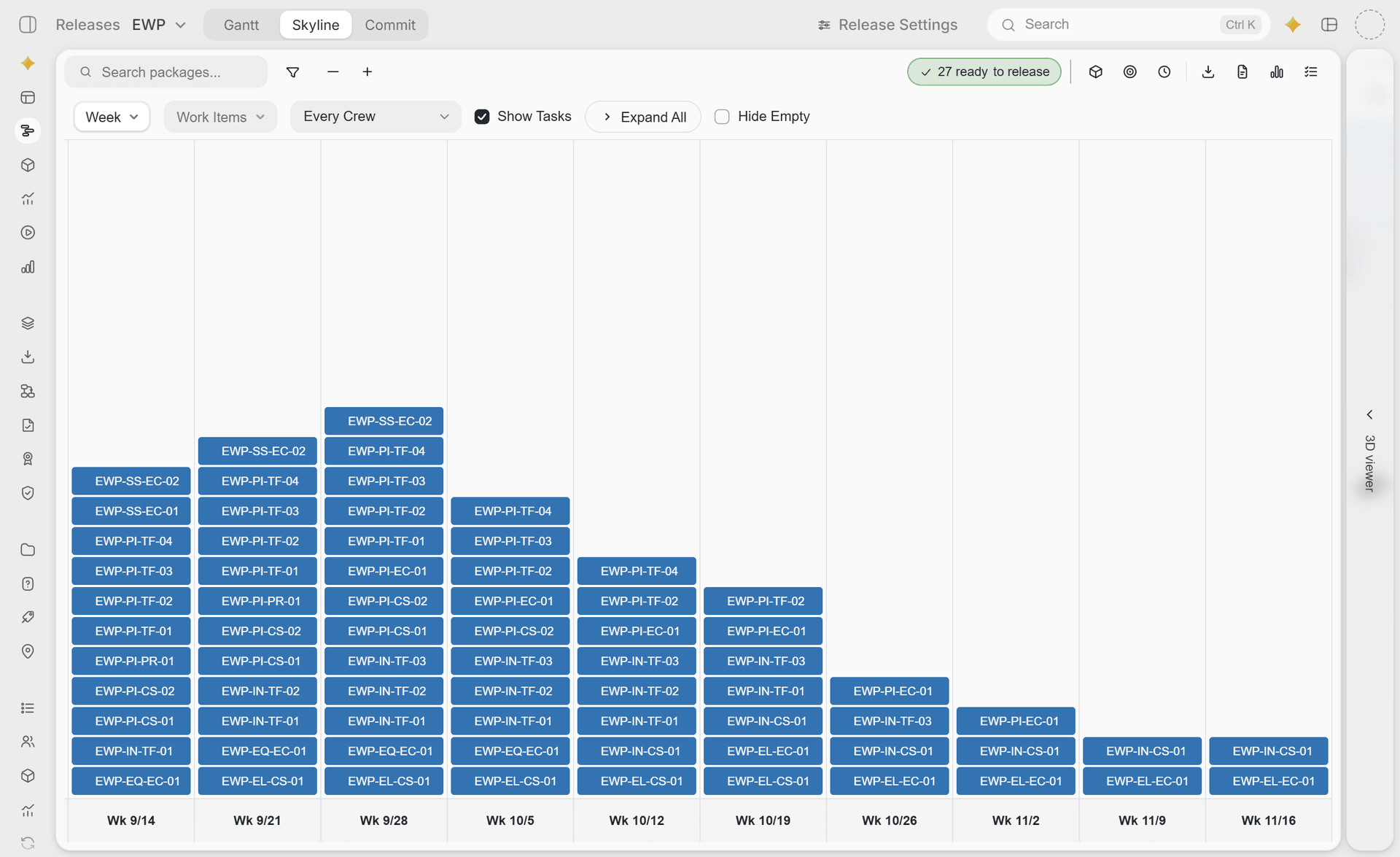
A skyline is one bar per EWP on its planned release week, colored by status, with documents IFC over total documents inside each bar and the open HOLD count on it. Linked to the Level 3 schedule, it shows a package in the register with no schedule activity as a gap, and an activity with no package as another. The owner reads the lookahead meeting from one screen before it starts, and the contractor reads the same screen. How rules of credit work and what complete means for each package type carry the definitions behind the bars.
What a 4D Sequence Adds to a Bid
Played over the release plan, the model colored by EWP status over time, with ISO counts as labels, shows a construction manager where engineering will be complete when crews arrive. It persuades once the skyline has shown the numbers behind it. In openAWP the Releases page holds a Gantt, a Skyline and a make-ready list of open constraints on the same packages, and 4D simulations play planned against actual dates on the model.
None of this automates engineering. Allocating documents, checking model attribution before IFC, rolling up progress and producing the cover page are bookkeeping, and bookkeeping is what software should carry so the discipline leads can engineer. Setting up the plan, the register and the review gate with an engineering contractor is part of AWP consulting. The register, the schedule and the rules that connect them stay with the project when the engagement ends.