
An engineering and procurement data warehouse is the central repository of structured project data, organized so that every dataset relates to every other through common identifiers. The document management system stays the system of record for documents and revisions, and the warehouse is the system of record for the data behind them.
This is the part of the information management stack that digital leaders are asked to approve and rarely get described in project terms. The layers below are the same ones a data team would recognize, named by what they hold on a capital project.
Three Layers, Named by What They Hold
The raw layer holds data exactly as it arrived from a source system, written once and never edited. On a project that means the register export from the document management system, the schedule export, the attribute export from the 3D model, vendor bills of material and packing lists, and the extracts from procurement and material management.
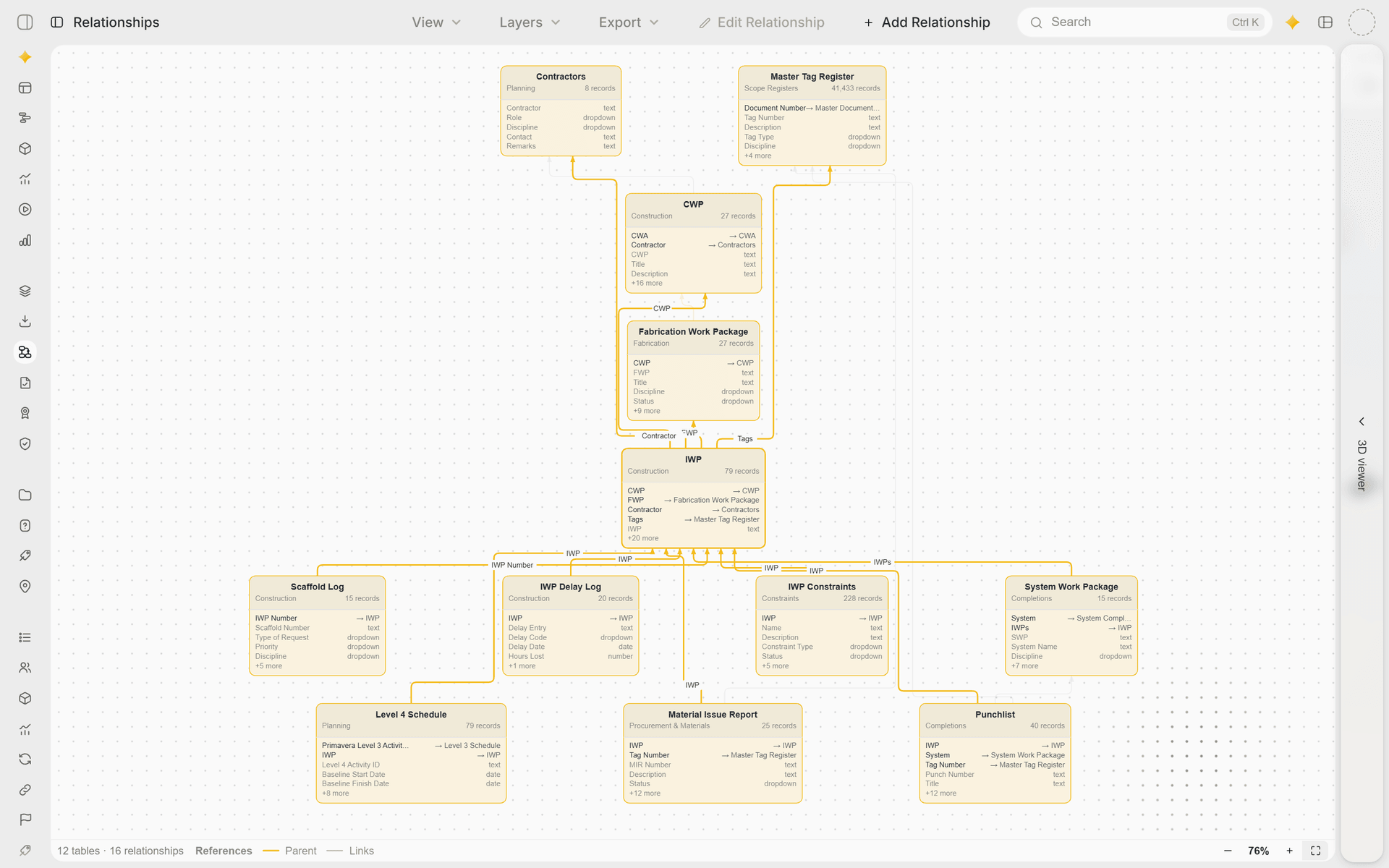
The validated layer holds the same data after the checks. Duplicates are removed, reference data is applied so that equipment classes, document types, area codes and unit codes are spelled one way, and the relationships are established, tag to EWP, document to EWP, purchase order line to CWP. History is kept, so last week's state can be compared with this week's. This is the layer that matters, because the relationships and the checks are what make the data trustworthy.
The reporting layer holds the views that dashboards read. EWP and PWP dashboard views, engineering progress by package, material readiness by CWP, data quality by register. Nothing is calculated in a dashboard that is not already a view here.
Every Dataset Carries Its Package
Engineering data is linked to its EWP and VEWP. Procurement data, including purchase orders, expediting records, logistics and material status, is linked to its PWP. Tags, documents, materials, systems and 3D objects relate to one another through those packages, so a reader can follow a CWA down to a single tag and back. The CII AWP Data Requirements Implementation Guideline gives a common starting list of what to track, and the project's own data requirements document makes it specific.
Who Reads and Who Writes
Most users read. Published views are surfaced in SharePoint on a daily or weekly cadence, as spreadsheet views of the same data, so a planner who lives in Excel still reads the validated numbers. Creation, modification and administration are limited to the people responsible for data quality.
The contractor's information manager administers access, defines the load processes with their sources, targets, transformation rules, refresh frequencies and reconciliation checks, and keeps an interface register of every integration with its owner and frequency. Data is loaded only after validation, and the cross-system checks described in weekly data reconciliation run before any EWP or VEWP is released.
Standard Services, Sized to the Data
A data integration service and a SQL database are enough when the data arrives structured and validated. Heavier processing engines are added only when transformation, enrichment or scale demand them, and a service is never introduced because a vendor prefers it. When a project organization already runs such a platform, the warehouse connects to it for ingest and egress.
The warehouse, its published views and its validation rules sit in the owner's tenant and stay there when the engagement ends. AWPBI's data integration service builds and runs the loads and the views, with the owner's information manager holding the standard.